AZ-600 Exam
You have an Azure Stack Hub integrated system that uses an Active Directory Federation Services (AD FS) identity provider and capacity-based billing.
You have a plan named Plan1 that has the following quota configurations for Microsoft.Compute:
✑ Maximum number of Availability Sets: 10
✑ Maximum number of virtual machines: 50
✑ Maximum number of virtual machine cores: 100
✑ Maximum number of virtual machine scale sets: 10
You link two offers named Offer1 and Offer2 to Plan1.
Two user subscriptions named Customer1 and Customer2 are created based on Offer1. A user subscription named Customer3 is created based on Offer2.
Customer1 receives a warning that it provisioned 50 virtual machines.
You need to ensure that Customer1 can provision an additional 25 virtual machines within its existing subscription. The solution must NOT affect the quotas of the other user subscriptions.
Which two actions should you perform? Each correct answer presents part of the solution.
NOTE: Each correct selection is worth one point.
Add NewPlan as an add-on to Offer1
Create a new plan named NewPlan that has the maximum number of virtual machines quota set to 75
Add NewPlan to the Customer1 user subscription
Create a new plan named NewPlan that has the maximum number of virtual machines quota set to 25
Update the quota for Microsoft.Compute in Plan1 to have the maximum number of virtual machines set to 75
Create a new offer named Offer3 based on Plan1 and create a new user subscription for Customer1 by using Offer3
You have an Azure Stack Hub integrated system that connects to the Internet.
You are migrating several Hyper-V workloads to Azure Stack Hub. Billing for the workloads is consumption-based.
You need to predict the ongoing Microsoft subscription charges for the workloads.
You run an Azure Migrate assessment and receive the output shown in the following table.
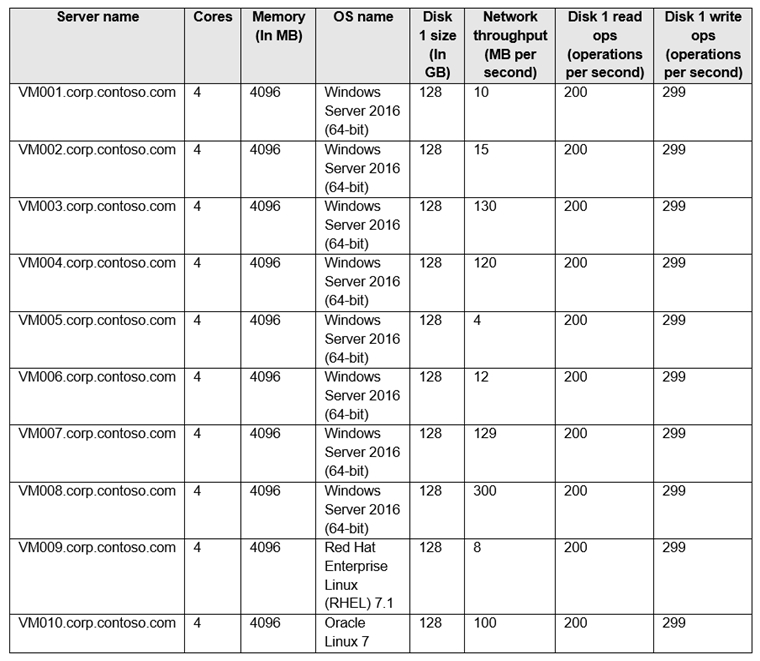
The values from which three columns affect the ongoing Microsoft subscription charges? Each correct answer presents a complete solution.
NOTE: Each correct selection is worth one point.
Disk 1 size (In GB)
Network throughput (MB per second)
Cores
Memory (In MB)
Disk 1 read ops (operations per second)
Disk 1 write ops (operations per second)
OS name
Your company is a Cloud Solution Provider (CSP) that provides Azure Stack Hub services to multiple customers in a multitenant environment.
User subscriptions are linked to Azure CSP subscriptions for billing reconciliation.
You need to view the usage of all the customers for the current day and the last seven days.
What should you do?
Query the Azure Stack Hub usage API
Query the Partner Center Usage API
From Partner Center, download the daily-rated usage reconciliation CSV
From Partner Center, view the usage associated to the Azure Partner Shared Services (APSS) subscription
You have an Azure Stack Hub integrated system.
You need to create a new offer that can be used only by an operator to provision user subscriptions. The solution must simplify the process for users to create resources.
Which type of offer should you create?
public with a base plan only
delegated with a base plan only
private with a base plan only
decommissioned
You have an Azure Stack Hub integrated system that connects to the Internet.
You need to enable multitenant billing.
What should you do first?
Generate a service principal to connect the Azure Billing API to Azure Commerce
Run the New-AzResource cmdlet
Create a blob storage account named AzSCommerceStaging that stores CSV usage metadata before you send the metadata to Azure Commerce
Email the registration subscription ID, resource group name, and registration name to azstcsp@microsoft.com
Unlock All Questions
You are viewing the free preview. Purchase a plan to access all questions, answers, and detailed explanations.